

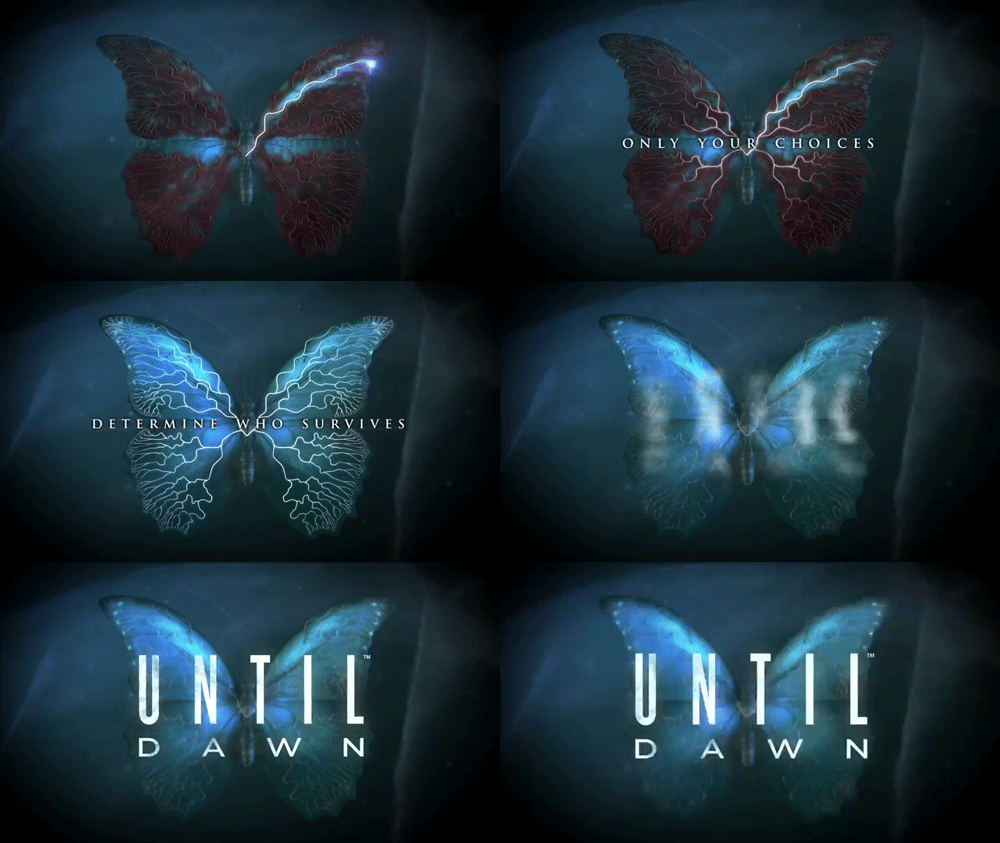
I’m almost finished editing The Lovelycraftians’ playthrough of Until Dawn (2024), hosted by KT, and sometimes I like to reflect on the games we play—relating them back to my own life experiences.
In Until Dawn, as with many interactive fiction games, you make choices that influence the game’s outcomes. Think of it like the old Choose Your Own Adventure books, but with quick-time events and characters you may or may not actually care about.
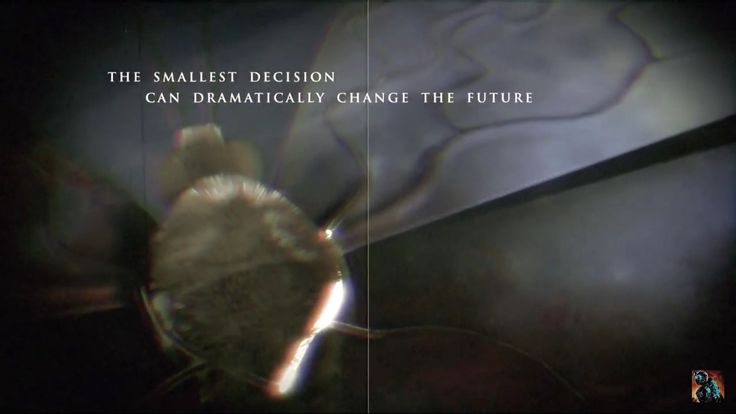
These choices and their consequences are tied to the concept of the butterfly effect, a term popularly associated with mathematician and meteorologist Edward Norton Lorenz. In his paper, Predictability: Does the Flap of a Butterfly’s Wings in Brazil Set Off a Tornado in Texas?, he questioned whether small changes in initial conditions could lead to vastly different outcomes.
He wasn’t the first to explore the idea, but the poetic imagery of a butterfly stuck—certainly more so than his original metaphor of a storm caused by a seagull (because, let’s be honest, seagulls aren’t exactly poetic).
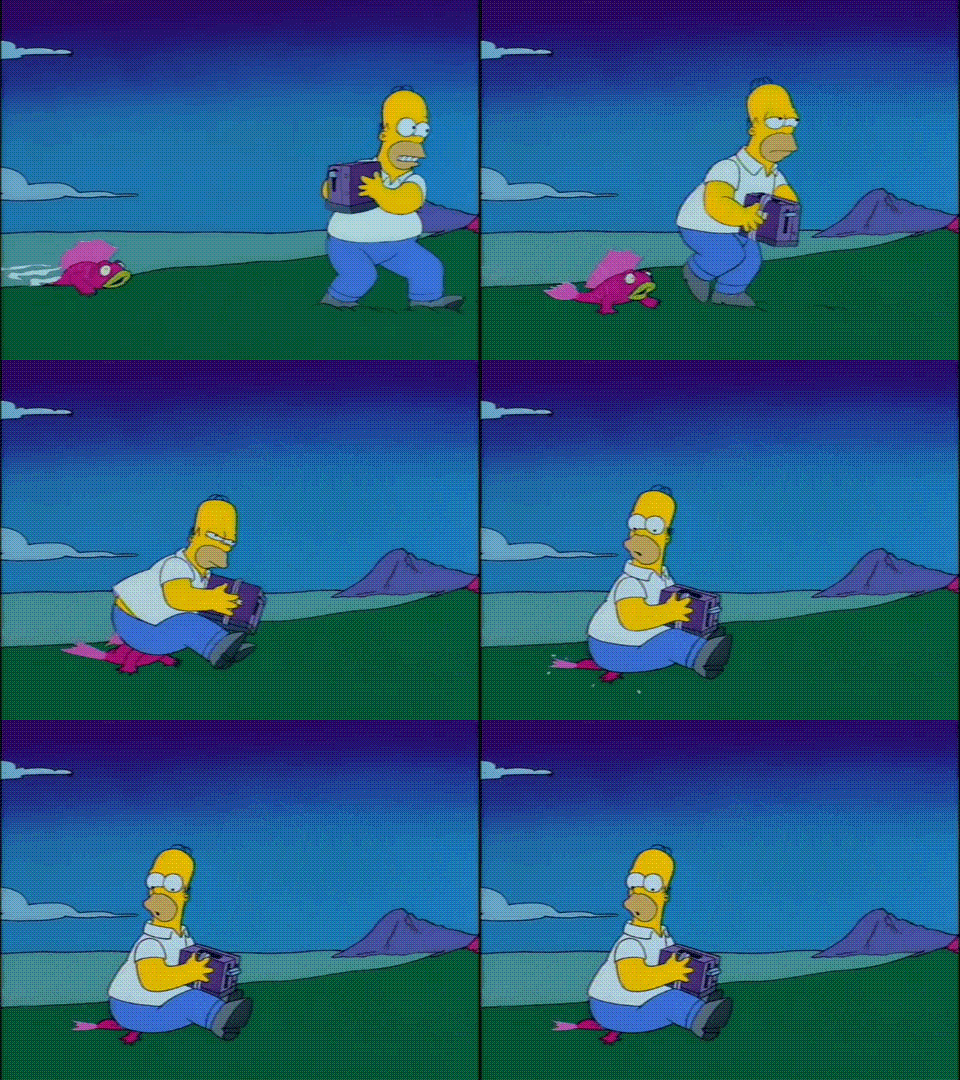
The butterfly effect appears frequently in media and literature. I even remember a Simpsons: Treehouse of Horror segment where Homer keeps using a time-traveling toaster to “fix” his timeline—only to make things increasingly worse. Ray Bradbury also used the butterfly as powerful symbolism in A Sound of Thunder. These stories—and the chaos theory they hint at—pose a poetic question: how much do the smallest things really matter?
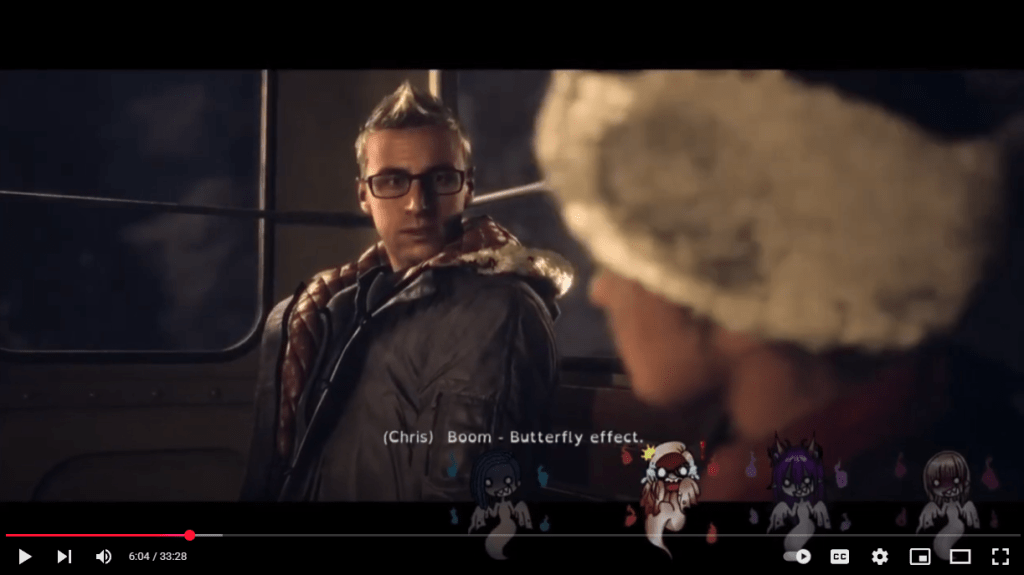
One of Until Dawn’s characters, Chris, explains the theory to Sam as they make their way to their mourning friend’s winter getaway. Sure, he uses it to slut-shame a young woman (which says more about his character than the game’s themes, honestly), but that’s a separate discussion.
Still, while editing that scene, I started reflecting on my own butterfly moments. The moments that quietly changed everything. At first, I wasn’t sure I could pinpoint any single experience that shaped where I am now.
I don’t even remember how it came up, but I mentioned I had taken a “Writing for Radio” course in college. At the time, it felt like a passing comment, but it stirred something in me. I’ve been journaling again lately (a practice I’ve neglected for years), trying to make sense of the political chaos around me. That return to self-reflection helped me realize just how pivotal that radio course was. And since it directly ties into The Lovelycraftians, it feels worth sharing.
A Complex Figure-Eight Motion
I went to an arts college in Chicago after moving from New Jersey, becoming the first in my immediate family to attend school out of state. We were poor, sometimes houseless, often without utilities (we called them “Pilgrim Nights”), and regularly relied on charity food pantries. I know the taste of powdered milk a little too well.
I share this not for sympathy but to explain why going to college (despite the looming debt) was such a monumental step. It was a chance at more opportunities than I ever would’ve had back home.
(Side butterfly: I only moved to Chicago because Emerson College in Boston waitlisted me.)
I enrolled in the “Writing for Radio” course after a forced two-year break due to finances. By then, most of my friends had graduated. I was determined to finish because so many people warned me: the longer you wait, the less likely you’ll return. And, I had received so much support from loved ones, I couldn’t waste the chance they helped me fight for.
(Side butterfly: I was obsessed with radio dramas thanks to a beloved teacher who played an episode of Superman vs. the KKK during a “Writing for Comics” class.)
Despite the interest, I was nervous to take the class because I hadn’t done anything in the radio department before and not many people in the Creative writing department seemed familiar with it. This was 20-something Samantha: highlighter-pink hair and a mountain of social anxiety. I worked full time at an underpaying, overworking startup, but I managed to cram my courses into one weekday (pretty much my only day off).
Life at that time was chaotic. I was dealing with financial instability, family mental health struggles, and the fallout of a cheating boyfriend (who I wasn’t sure would stay my boyfriend and still lived with at the time). But this class? It was a respite. It was collaborative, creatively fulfilling, and unexpectedly validating. I think I was in charge of tracking story/continuity (though I might be misremembering). Still, the skills I practiced there ultimately laid the groundwork for my career in Knowledge Management and, eventually, Instructional Design.
That class gave me confidence. It told me I was capable. And I desperately needed that, especially, during that time. Amid the personal fires I was putting out, it became something shiny and good to hold onto.
Vortex Rings
As a class, we wrote a full radio drama (a feat in itself). Because I wasn’t a radio major, I assumed my involvement would end with the semester. But then the teacher offered me an Assistant Director position so I could continue with the project over the winter semester.
I was shocked. Elated. Seen.
It felt like a rare moment of validation. But that moment didn’t last.
Because winter semesters weren’t part of my financial aid package, I had no way to pay for the credits. Even now, I imagine there might have been a way to make it work, but I was working full time and sending money home to help my mom and sibling. I couldn’t afford to risk losing my job or taking unpaid time. Not to mention that was my only way of having health insurance. And it didn’t give me much time to figure out a game plan, especially one that I had no immediate idea where to begin to find answers (the financial aid department was a nightmare and little help).
So, I had to say no.
And that’s the thing about being poor, you have to say no to a lot of amazing opportunities. And this one hurt.
I recommended another classmate for the role, she was brilliant and deserving. And she would later giddily tell me the news and I remember congratulating her. I remember thinking how I hoped my own disappointment didn’t cloud my genuine excitement for her. I didn’t mention I had been offered the position first or my reasons declining, I didn’t want my hardship to dim her moment.
But still, it was a deep, quiet heartbreak.
The semester ended but life kept going. I graduated and kept working. And I would eventually get an email from that teacher letting me know that the show had been produced and when it was premiering. When it eventually aired on the college station, I couldn’t bring myself to listen. I was proud of the work we had done, but the regret stung too much.
Forward Propulsion
Eventually, I broke up with that ex. A lot later than I should have but sometimes lessons stick better with time. This would have it own butterfly effects but I’ll leave that for another time.
In a new job, I started organizing policy updates no one else was tracking. That initiative led the company to create a new position for me in Knowledge Management. I would credit having my hard work recognized by that teacher as what bolstered my confidence in these skills and caused me to jump on a task where I saw a need. And that job would lead me eventually to what I am doing currently, Instructional Design.
And through my side gig of working at a friend’s comic shop I met folks starting a tabletop RPG podcast. They asked if anyone would be interested and I immediately jumped at the opportunity. My love for radio drama hadn’t faded, it had just been waiting. Actual play, I’d argue is just an offshoot of radio drama with an improvisational storytelling twist.
(Side butterfly: My first job in Chicago was working at a comic book store. I got the job because I was brave enough to email the manager of the store and while they weren’t hiring at that time, when I mentioned I was from New Jersey, where he was from as well, the minute an opening happened he offered me the job. He would eventually open up his own store and I still work there from time to time 16 or so years later. He is now one of my oldest and most treasured friends. Funny how things unfold.)
That one regretful “no” taught me to say a lot more “yes.” And while I’m proud of that, I do wonder what would be different if other factors hadn’t stopped me?
The Immeasurable Whole
What if I hadn’t had to worry about rent or tuition? What if I’d had health insurance through my parents, not a job I couldn’t afford to lose? What if I hadn’t needed to save for months just to leave a bad relationship?
What if others like me didn’t have to say no to so many things?
What have we missed out on as a society because someone couldn’t afford to say yes?
My story is one of many butterfly effects. Not all of them are by choice. And while I’ve faced many barriers, I recognize the privilege I do have (especially as a white person navigating poverty). That’s a butterfly effect that’s harder to see when you’re far removed from the struggle.
Maybe writing this is another small flap of a butterfly’s wing. Maybe I’m romanticizing a hard time in my life. The truth is, we can never know.
Life isn’t a video game. We don’t get to reload the save and try a different option. But it’s an interesting personal thought experiment to look back and wonder.
“You may not see it now,” said the Princess of Pure Reason, looking knowingly at Milo’s puzzled face, “but whatever we learn has a purpose and whatever we do affects everything and everyone else, if even in the tiniest way. Why, when a housefly flaps his wings, a breeze goes round the world; when a speck of dust falls to the ground, the entire planet weighs a little more; and when you stamp your foot, the earth moves slightly off its course. Whenever you laugh, gladness spreads like the ripples in the pond; and whenever you’re sad, no one anywhere can be really happy. And it’s much the same thing with knowledge, for whenever you learn something new, the whole world becomes that much richer.”
Norton Juster, The Phantom Tollbooth
 Samantha LaFountain